Showing posts with label teaching philosophy. Show all posts

Thursday, 2 August 2012

Paper Recycling Monster

Students! Stop throwing worksheets, scrap paper, and your tests you did badly on into my garbage bin!


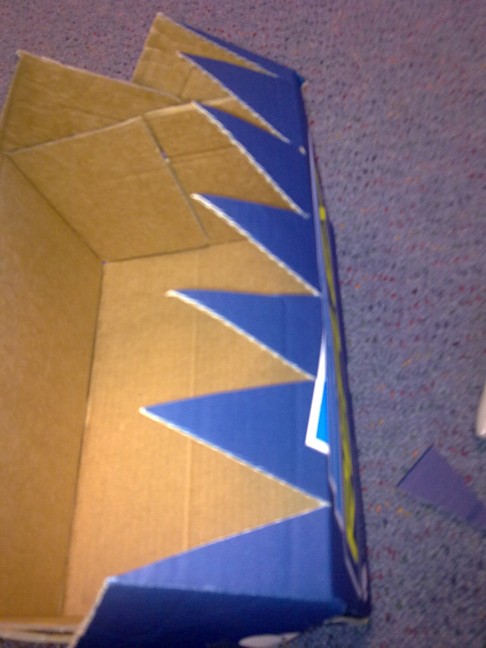
I decided it was about time I had a paper recycling system for my room. I need to stand by what I believe and demonstrate these ideals to my students. Inspired by some cute stuff on Pinterest, I decided my system should be a monster. Here is how I did mine:

We use a lot of paper, and usually use the box lids to collect exam papers together, while the rest of the box is used less often. Then some paper, black marker, tape (and/or staples) and scissors.


 Cut the side part-way down.


Then fold them over to create an angle for the mouth and tape down or staple. I stapled the first one I did and some staples held while other didn't. This one I used just tape.


 Then cut out some triangles to give some teeth.


Cut some eyes out of paper and draw some pupils. Cut tabs on the bottom.


Turn the tabs in opposite directions and tape down.


Monster! This one is going to hold our student absence sheets in the staffroom.


Sunday, 8 April 2012

Some thoughts about games

Further to my previous post about up-skilling my students, I'm dwelling on one of my favourite things - games.

I love maths games and I try to use them in class, but I do find they meet with mixed success, and it often isn't the maths that is the problem. I began by thinking "Kids these days don't know how to play games" and feeling sad about that. But sometimes I go to a friends place for dinner or a party and a board game comes out, and sometimes there is an adult who doesn't seem to really "get" how to play the game. So I suppose it isn't generational, it's just that not everyone plays games and I don't normally associate with that sort of person.

I think I should persist though, because using maths in a game seems like another level to me. Once the student has a good grasp of the concept, playing a game about it can work on using the knowledge/skill strategically, reasoning about the knowledge, and gaining more fluency at applying the skill. Which potentially also provides differentiation, (although I might be reaching here) as one student makes the most obvious move while another considers multiple options and chooses the best one for the situation.

Over the years I have played a lot of games in class, that I have discovered or invented (mostly invented). I spent a lot of my early part-time years throwing myself into making cards for cool games I came up with and then they didn't work that well or I got bored of them. The legacy I will leave behind me in the teaching world is a large pile of neglected hand-made games. But I will be sharing my more successful creations here in the hope someone else might enjoy them. Stay tuned!

Thursday, 5 April 2012

What kind of students do I want to pass on?

I've been thinking a lot about what it is I am actually trying to achieve as a maths teacher. With good students it's easy to not question the standard form of maths education, but with middle and lower-achieving classes I question the relevance of a lot of content.

I've been slowly reading through some of the blogs I found in my first over-excited blog weekend, and after reading all of exzuberant and infinigons, I've thought a lot about quality teaching, assessment, problem-solving skills and engaging, relevant learning activities. Reading this post today made me think about what the key, transferable, whole-of-life skills are that I should be trying to impart. If I taught at the kind of school where many kids went to university I might not care as much about this, but probably 50% of our students won't do maths in year 11 and 12, and only a handful will be studying any mathematics after school. So what the hell are we doing? And why?

This is a big problem and I have a short attention span but I kind of continued the thought on a slight tangent.

Today I was also making up a new maths game (as you do), and I though about how most of my students aren't great at playing games that require much strategy. And in fact a lot of the "cool", engaging activities we want to do, anything that requires independent thought, critical thinking, deep understanding, dealing with open-ended problems, etc. etc. seems to stump our kids.

So I thought, that's something to start thinking about. This type of thinking, dealing with these types of problems and activities, these are all just skills too. They need to practise them. We need to be persistent, and we need to maybe scaffold learning how to learn that way?

I have the top year 7 class. They are pretty good at maths so far (most of them) and from here I have to try to turn them into hard-working, keen, interested, engaged, skilled maths learners. And maybe that means I need them to be:
  • used to learning games, playing games, strategising and coming up with variations to games
  • used to solving problems
  • used to working on projects
  • used to working in groups
  • used to reasoning about and communicating concepts
  • used to tackling open-ended problems
as much as, or even instead of:
  • doing lots of drill questions from textbooks or worksheets 
Which means I need to make sure I'm doing these things. I've made a start on games and have some group projects about communicating concepts planned, but need lots more problem-solving especially.