Saturday, 13 April 2013

Numeracy Display on the Door

This term my school's Numeracy Team set up a little competition for a Numeracy Display. This is the second one actually. At the end of last year each faculty had to put up a display about Numeracy in our subject area.

This time the challenge was to pick a classroom door and decorate it with numerical facts or information relating to our subject area and the room number.

Here's my door, courtesy of my year 9 class:


 The secondary idea here is that we'll work towards having displays like this on all the classroom doors, not only promoting numeracy, but making it easy for new students to find their rooms!

Tuesday, 12 March 2013

Yes/No Game with Numbers

A simple premise, and very adaptable. Plus it gives us a nice opportunity to get up and get moving!

Here's how it goes:
  • Label one area (e.g. one side of the classroom) with "Yes" and another area with "No"
  • Give each student a number.
  • Ask yes/no questions about the numbers.
  • Students have to go to the correct area, holding their number where you can see it to check.


For example, today I played this with my Peer Numeracy roll call (which was extra good because it was a small group and the year 10 mentors helped check and helped the students who struggled). First I did numbers in the hundreds, then in the thousands.

Some questions:
  • Are you even?
  • Are you more than 50?
  • Are you more than 400?
  • Look at your tens digit. Is your tens digit more than 3?
  • Look at your hundreds digit. Is your hundreds digit odd?
  • Add up your digits. This is your digit sum. Is your digit sum even?

And so on. At the end of each set of questions, I got them to line up in ascending order and collected the numbers and gave out the new numbers.

I've also played as revision with year 7 classes, looking at number properties and special numbers, using questions like:
  • Are you odd?
  • Are you prime?
  • Are you a multiple of 3?
  • Is 4 a factor of you?
  • Are you palindromic?
  • Are you a square number?
  • Are you a triangular number?
  • Are you in the Fibonacci sequence?
  • If you add 3 to yourself, are you a multiple of 5?

Some other ideas:
  • Use decimal numbers and ask questions about the digits in certain places, to reinforce place value
  • Use fractions and ask questions about the numerator and denominator (to reinforce those terms)
  • Use algebraic terms and ask about "are you a like term to ...?" or "is .... a factor of you?"
  • Give students shapes and ask questions about their properties

This also makes me think about getting students into groups for group work. Some ideas:
  • Give students algebraic terms and get them to form groups in their like terms
  • Give students numbers and get them to form groups of multiples
  • Give students shapes and get them to find the same type of shape

Tuesday, 5 March 2013

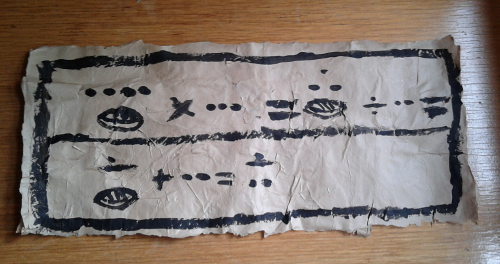
Numbers of the Ancient World

Last year my year 7 class began by exploring Numbers in Our World, including making fake papyrus and painting Egyptian numerals on them.

I loved it so much, we did it again this year. Maths in the art room is so much fun!


This time I let them choose which number system to paint numerals from.


I also encouraged them to paint a calculation rather than just a number, which some of them did.


One painted her birth date and time.


Ever wondered what it would look like if the Ancient Egyptians did integration? Now you know.


Someone get this kid some extension work!

Friday, 1 March 2013

Circle Geometry Puzzle

Just a little bit of extra fun in Circle Geometry for my Extension 1 students.


I'd like to try more of this sort of thing, but it was hard work! Maybe the students should make their own as a homework assignment.

Tuesday, 26 February 2013

Multiples Pig

When I was at high school, we played a lot of card games. A lot. All the time.

Pig was one I had forgotten about, until I was reintroduced to it by some students as Spoons. A good description of the game can be found here.


In Pig the aim is to get four of a kind. In Multiples Pig, the aim is to get 4 numbers that are all multiples of the same number (not including one, and I usually disallow twos as well).

All you need are some number cards. Here are some that go from 3 to 50 that work quite well:


My basic summary of the rules:
  • Players sit in a circle
  • Deal 4 cards to each player
  • The rest of the deck is to the right of one player
  • That player picks up from the deck then discards to their left
  •  The next player picks up from those discards and discards to their left and so on. So each player picks up from their right, discards to their left.
  • There are no 'turns', play continues as quickly as the players can play
  • The first player to create a hand of 4 multiples puts their hand on their nose
  • Anyone who notices this can also put their hand on their nose
  • The last player to put their hand on their nose 'loses' (loses a life, gets a letter of the word pig, etc.)
  • Shuffle, deal and play again!

The best part of pig is the subtle silent waiting for the last person to notice!

Monday, 25 February 2013

Rabid Dogs

Teaching a difficult class is like looking after a rapid murderous dog.

You cannot stop it being rabid and murderous, but you can be sensible about how you look after it.

If you don't have a plan to keep it contained or occupied, things will go badly. If you forget your past experiences and fool yourself into thinking it can control itself and rise above its situation, things will go badly.

Things will occasionally go badly. And you start to feel that its somehow your fault the dog is rapid and murderous.

It isn't your fault.  But you've got to stop thinking you can fix the dog, and accept that all you can do is contain it, and work on that.

Wednesday, 20 February 2013

"I have...Who has?" for Simplifying Surds

My new addiction is "I have... Who has...?" cards. I'd seen the idea around a bit, also called "Follow me" or something like that, but never tried any.

Then I found a free example for telling the time from superteacherworksheets and used it with my year 10s.

The basic idea is that the cards make up a chain of matching items. They can be question-and-answer style or just different ways of representing the idea. The time cards have a clock face for "I have..." and a written time for "Who has...?"

We played just by calling out. So I took a card and read my "Who has...?" question. The students all look at their clock faces and whoever has that one answers "I have..." and follows by reading their question. When we got back to me, the game was done.

Of course, you have to have everyone paying attention! This was the hardest part for the class.

Other ways to play, I believe, include using it as a way to get everyone into a circle or a line in a random order, and you could also get the students just to put the cards into order as a kind of matching activity.

Today I tried my own little revision one with year 11 Mathematics. Yesterday we simplified surds, so today we checked our knowledge with these cards:


This was a bit of fun, quick revision and a good check of who still needed help with the work. Also they are very simple to make if you don't need images! So I plan to do lots of algebra ones.

I also suggested to my resident PDHPE teacher that it would be a hilarious game for revising knowledge of STDs. Not sure if he'll take me up on that one.