Sunday, 13 May 2012
Wall Words
Some difficult-to-spell maths words and their other forms, colour-coded by word type and somewhat grouped together by use. I'm determined to have one of the prettiest rooms in the school.
Clock Wall
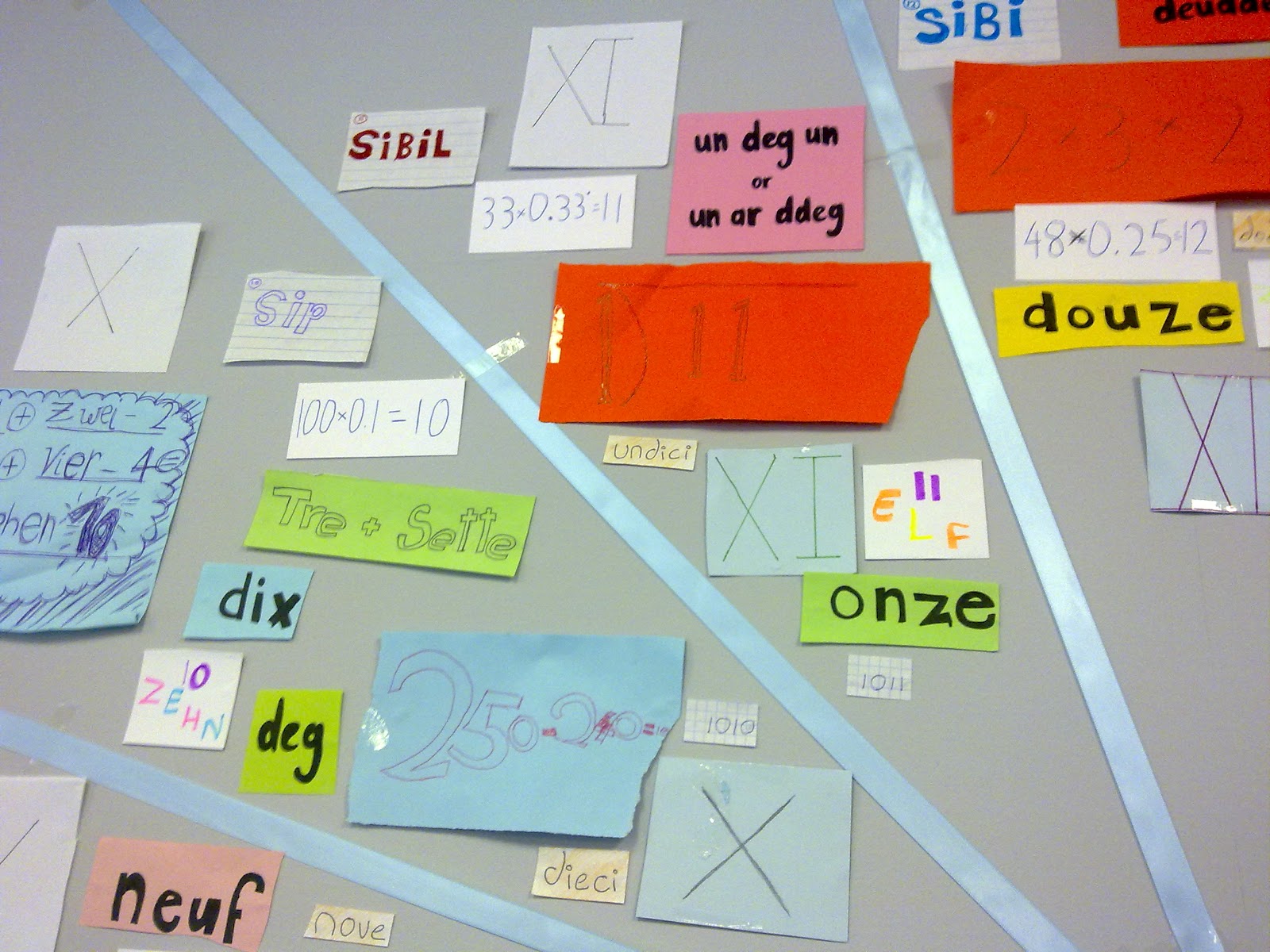
After a long time dreaming of it, I have my clock wall. The "Pop Quiz Clock" is available at ThinkGeek (mine was a present from my lovely sister). I divided the wall behind with ribbon and we are steadily filling it with expressions and numbers in other languages.
This is how it looked at first, before the walls were painted:
After repainting I set some homework that involved preparing a number for the wall as part of my homework menu, and consequently it has grown:
So far it is the work of year 7 and myself, and Extension 1 have made a contribution too.
This is how it looked at first, before the walls were painted:
After repainting I set some homework that involved preparing a number for the wall as part of my homework menu, and consequently it has grown:
So far it is the work of year 7 and myself, and Extension 1 have made a contribution too.
Saturday, 5 May 2012
Algebra - Smarties and other unknowns
After our yarn-up on Friday we started looking at what algebra is about on Monday, using the excellent resources provided by my Maang colleagues.
The core of the idea was to start with concrete and then visual examples that make it clear why we are using a pronumeral. We begin with boxes of smarties. With the boxes unopened, the number of smarties in the box is unknown. We can call it b. Then what does b+1 look like? What does 2b look like? What about 3(b+2)? Students had whole boxes of smarties and spare smarties to make all these arrangements and then draw them. Then each student opened their box of smarties and knew the value of b, which could then be used to find the total number of smarties in each of the pictures they drew for the expressions.
The next worksheet involved trains with an unknown number of people, n, on them, and some extra people (possibly people waiting on the platform). Then mouseholes with an unknown number of mice in them and extra mice outside. Through all three of these there were expressions with matching visuals, and then substitution of different values for the pronumeral.
In hindsight it seems simple but I was amazed at how well they understood the concepts every step of the way. The bit that really blew me away was how well they understood the use of brackets. I've never thought of factorising and expanding as something you could do in a concrete way, but here it was, and they were instantly successful at it, without any examples or instructions. After all, if b is an unknown number of smarties in a box, then 3(b+2) is obviously a box with 2 spare smarties drawn 3 times. But many of them didn't even draw them in groups, they expansion was clear to them - that's 3 boxes and 6 extras.
The trains worksheet included this one: "2(n+5)-4". The ease with which the students worked this out impressed me. "Well that will be two trains and ten people, and so with the minus 4 it's two trains and 6 people." Then they drew it. While I stand there dumbfounded. All of this expression writing also gave us the opportunity to discuss "style", 1k vs k, 2k vs k2 vs k+k, etc.
Thursday we followed up with more worksheets on the same idea, and some simplifying expressions and more substitution. They cruised through it.
Now we are moving on to equations, and starting our video project. More on that later - and fingers crossed it works out!
The core of the idea was to start with concrete and then visual examples that make it clear why we are using a pronumeral. We begin with boxes of smarties. With the boxes unopened, the number of smarties in the box is unknown. We can call it b. Then what does b+1 look like? What does 2b look like? What about 3(b+2)? Students had whole boxes of smarties and spare smarties to make all these arrangements and then draw them. Then each student opened their box of smarties and knew the value of b, which could then be used to find the total number of smarties in each of the pictures they drew for the expressions.
The next worksheet involved trains with an unknown number of people, n, on them, and some extra people (possibly people waiting on the platform). Then mouseholes with an unknown number of mice in them and extra mice outside. Through all three of these there were expressions with matching visuals, and then substitution of different values for the pronumeral.
In hindsight it seems simple but I was amazed at how well they understood the concepts every step of the way. The bit that really blew me away was how well they understood the use of brackets. I've never thought of factorising and expanding as something you could do in a concrete way, but here it was, and they were instantly successful at it, without any examples or instructions. After all, if b is an unknown number of smarties in a box, then 3(b+2) is obviously a box with 2 spare smarties drawn 3 times. But many of them didn't even draw them in groups, they expansion was clear to them - that's 3 boxes and 6 extras.
The trains worksheet included this one: "2(n+5)-4". The ease with which the students worked this out impressed me. "Well that will be two trains and ten people, and so with the minus 4 it's two trains and 6 people." Then they drew it. While I stand there dumbfounded. All of this expression writing also gave us the opportunity to discuss "style", 1k vs k, 2k vs k2 vs k+k, etc.
Thursday we followed up with more worksheets on the same idea, and some simplifying expressions and more substitution. They cruised through it.
Now we are moving on to equations, and starting our video project. More on that later - and fingers crossed it works out!
Friday, 27 April 2012
Algebra - 8ways, literacy, and unmasking our demons
I had some exciting ideas about things to do in our first look at algebra with my lovely year 7s. In the process of asking people for input, I got a bunch of better ideas from them (although my original ones will probably still appear).
For the first lesson, I took the inspiration from 8ways and we had a 'yarn up', pretty much as described here. The lesson got off to a good start down the comfortable-chat road with a discussion of the results from last term's feedback survey, the holiday homework, my new hair colour etc. I put up the new topic title: "Patterns, Algebra and Equations" and immediately there were groans and protests. With our scrap paper in front of us, I started asking questions. "What do you know about algebra?" "Have you done any before?" "When did you first learn about it?"
They knew some good stuff. It involves letters. It is where letters represent numbers. Usually you have to find out how the letters relate to the numbers. Most of them hadn't done any before, they said. Some had.
They had some fears, which came out when talking about their first meetings with algebra. "I first heard about it when my stepsister was saying how hard it was." "I looked over my sister's shoulder and couldn't understand anything on the page."
"So you hate algebra because other people told you they hate it?" They laughed and admitted it.
Someone said something about shapes representing numbers as well, instead of letters. Suddenly others realised they had done that too, and they didn't realise that was algebra, and that wasn't so hard. I said that I thought letters were easier to write when the algebra got more complicated. "It gets harder?!" Groans again. I explained that is wasn't hard as long as you learn one step at a time and that soon they would be able to do stuff that looks completely confusing now.
Then I used some ideas that were generously shared on the Maang group, exploring literacy and linking pronumerals to other "pros" they might know (pros and cons, pro-labour or pro-liberal, and pronouns) and discussing why pronumerals are used. We talked about the different types of symbols that can be used in place of numbers. I was taught how to pronounce xi, and admitted that at uni I referred to it as "squoogle". Other Greek letters were discussed in some depth. "It's definitely psi, it looks like the ninja weapon." "Oh yeah, like Raphael uses." "Who's Raphael?" Kids.
It took the right group of kids, but this was one of the most positive, enjoyable lessons I've had. It was a good way to start the topic, a good way to spend a Friday afternoon lesson, and a good way to get all the feelings and fears out in the open.
For the first lesson, I took the inspiration from 8ways and we had a 'yarn up', pretty much as described here. The lesson got off to a good start down the comfortable-chat road with a discussion of the results from last term's feedback survey, the holiday homework, my new hair colour etc. I put up the new topic title: "Patterns, Algebra and Equations" and immediately there were groans and protests. With our scrap paper in front of us, I started asking questions. "What do you know about algebra?" "Have you done any before?" "When did you first learn about it?"
They knew some good stuff. It involves letters. It is where letters represent numbers. Usually you have to find out how the letters relate to the numbers. Most of them hadn't done any before, they said. Some had.
They had some fears, which came out when talking about their first meetings with algebra. "I first heard about it when my stepsister was saying how hard it was." "I looked over my sister's shoulder and couldn't understand anything on the page."
"So you hate algebra because other people told you they hate it?" They laughed and admitted it.
Someone said something about shapes representing numbers as well, instead of letters. Suddenly others realised they had done that too, and they didn't realise that was algebra, and that wasn't so hard. I said that I thought letters were easier to write when the algebra got more complicated. "It gets harder?!" Groans again. I explained that is wasn't hard as long as you learn one step at a time and that soon they would be able to do stuff that looks completely confusing now.
Then I used some ideas that were generously shared on the Maang group, exploring literacy and linking pronumerals to other "pros" they might know (pros and cons, pro-labour or pro-liberal, and pronouns) and discussing why pronumerals are used. We talked about the different types of symbols that can be used in place of numbers. I was taught how to pronounce xi, and admitted that at uni I referred to it as "squoogle". Other Greek letters were discussed in some depth. "It's definitely psi, it looks like the ninja weapon." "Oh yeah, like Raphael uses." "Who's Raphael?" Kids.
It took the right group of kids, but this was one of the most positive, enjoyable lessons I've had. It was a good way to start the topic, a good way to spend a Friday afternoon lesson, and a good way to get all the feelings and fears out in the open.
Tarsia
I love Tarsia. I have been using it as part of my year 7 Weekend Homework Menu quite successfully and as classwork or revision with other groups. It always takes longer than I expect for them to finish the puzzle and some kids just don't seem to have any experience with puzzles and take a while to understand what they have to do.
We also used them in our transition-to-high-school Maths Olympiads, with giant puzzles on coloured card to make it more interesting. I've sometimes done one large copy when I work with a class, and had some students solve that one and blu-tac it to the wall. (As well as their smaller copies, as you can see. They seem to be very proud when they finish them!)
Thursday, 26 April 2012
Refraction
Refraction is an awesome game. Starts out as a fairly simple puzzle with simple fraction concepts but gets up to the concept of adding fractions by converting them to the same denominator, so it is pretty impressive! And loads of fun and addictive.
I've finished, but I still have a few coins and cards to win :)
Subscribe to:
Posts (Atom)