
Friday, 10 August 2012
Vote for Batman
Last week I took nominations for new characters for my wall and today we had the voting. My year 7 class were the only ones who even noticed the nominations sheet and contributed to it, but year 9 got VERY excited about the voting, demanded that Batman be added and a fierce "vote for Batman" campaign was pursued for the few minutes of voting time. All classes during the voting came up with other ideas and this just shows that I will end up making DOZENS of characters and covering my whole wall with them. But for now, the winner was a Dalek, closely followed by Yoda. A significant step up in complexity from my previous choices!! But awesome. The kids were very keen to have maths tips in Yoda-speak, so I will probably do two.

Some Olympics
My year 9s are beginning data, and I thought we might try to find some graphs about the Olympics to interpret, so I googled "Olympics graphs" and came up with some fun things.
Olympic Records - Match graphs of Olympic records over time to the sport they represent. They suggested giving the list of sports as a "possible support" but I think that I would do that for all but the best classes. My year 9s tried this today and needed a lot of support on top of that. Still I think for those that did engage it was interesting and it enabled us to talk about measurement units and data trends. It would be a really cool activity with a higher-achieving class.
Graph the Olympics - A great idea for Olympics lead-up time especially, so a bit late for us, and again one best suited to a higher-achieving class or higher-year class. Lots of deep understanding possible in deciding how to best make predictions, which data to use, which measures to use etc. If I'm teaching in another 4 years, I'll try to remember this!
Olympic Logic Problems - Actually there are a lot of links here (in fact it's largely a list of the resources at nrich.maths.org), including to the Olympic Records activity above, but the ones I like best are the logic problem ones. I'm setting some for year 7s weekend homework menu this weekend.
And for a bit of a laugh, here are some graphs:
(although the comments make a point, the Venn diagram is off)
Olympic Records - Match graphs of Olympic records over time to the sport they represent. They suggested giving the list of sports as a "possible support" but I think that I would do that for all but the best classes. My year 9s tried this today and needed a lot of support on top of that. Still I think for those that did engage it was interesting and it enabled us to talk about measurement units and data trends. It would be a really cool activity with a higher-achieving class.
Graph the Olympics - A great idea for Olympics lead-up time especially, so a bit late for us, and again one best suited to a higher-achieving class or higher-year class. Lots of deep understanding possible in deciding how to best make predictions, which data to use, which measures to use etc. If I'm teaching in another 4 years, I'll try to remember this!
Olympic Logic Problems - Actually there are a lot of links here (in fact it's largely a list of the resources at nrich.maths.org), including to the Olympic Records activity above, but the ones I like best are the logic problem ones. I'm setting some for year 7s weekend homework menu this weekend.
And for a bit of a laugh, here are some graphs:
(although the comments make a point, the Venn diagram is off)
Thursday, 2 August 2012
Paper Recycling Monster
Students! Stop throwing worksheets, scrap paper, and your tests you did badly on into my garbage bin!

I decided it was about time I had a paper recycling system for my room. I need to stand by what I believe and demonstrate these ideals to my students. Inspired by some cute stuff on Pinterest, I decided my system should be a monster. Here is how I did mine:
We use a lot of paper, and usually use the box lids to collect exam papers together, while the rest of the box is used less often. Then some paper, black marker, tape (and/or staples) and scissors.

Cut the side part-way down.

Then fold them over to create an angle for the mouth and tape down or staple. I stapled the first one I did and some staples held while other didn't. This one I used just tape.


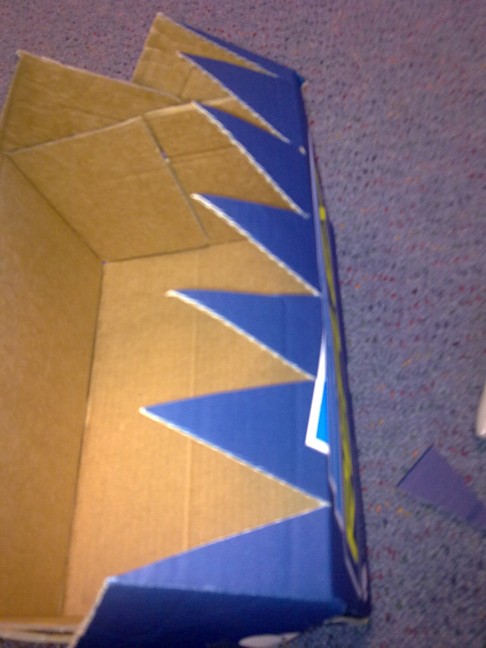
Then cut out some triangles to give some teeth.


Cut some eyes out of paper and draw some pupils. Cut tabs on the bottom.

Turn the tabs in opposite directions and tape down.

Monster! This one is going to hold our student absence sheets in the staffroom.


I decided it was about time I had a paper recycling system for my room. I need to stand by what I believe and demonstrate these ideals to my students. Inspired by some cute stuff on Pinterest, I decided my system should be a monster. Here is how I did mine:
We use a lot of paper, and usually use the box lids to collect exam papers together, while the rest of the box is used less often. Then some paper, black marker, tape (and/or staples) and scissors.

Cut the side part-way down.

Then fold them over to create an angle for the mouth and tape down or staple. I stapled the first one I did and some staples held while other didn't. This one I used just tape.


Then cut out some triangles to give some teeth.

Cut some eyes out of paper and draw some pupils. Cut tabs on the bottom.

Turn the tabs in opposite directions and tape down.

Monster! This one is going to hold our student absence sheets in the staffroom.

Tuesday, 31 July 2012
Paddlepop Stick Angles
I was inspired by a pin of a poster of angle types made from paddle-pop sticks.
Rather than making a poster each I decided to finally make some use of the string across my room. So they made one definition each and I made a title.


This was done in our first double-period on this topic, which was spent mostly reviewing types of angles, learning naming conventions for angles, and estimating and measuring angles. Oh and complimentary and supplementary angles. It was a busy time. We will probably add more diagrams when we do angles in parallel lines.

Thoughts for next time:
Another Pin down!!
Rather than making a poster each I decided to finally make some use of the string across my room. So they made one definition each and I made a title.


This was done in our first double-period on this topic, which was spent mostly reviewing types of angles, learning naming conventions for angles, and estimating and measuring angles. Oh and complimentary and supplementary angles. It was a busy time. We will probably add more diagrams when we do angles in parallel lines.

Thoughts for next time:
- Leave more time. Craft always takes longer than I think!
- Have more glue. It is hard to share around two glue bottles among 20 kids.
- Punch holes in card first, so the holes don't go through their writing.
- Do a demonstration one, largely to point out what size to write so that it is visible.
- Check spelling!
Another Pin down!!
Thursday, 26 July 2012
A Growing Addiction
The time that Pinterest is absorbing in my life continues to grow, so I need to resolve to actually use some of these ideas. I want to acutally use this pinboard as a working space of teaching ideas. Add things, but also use them and remove them. I'm determined to do what I can and adapt lots of the fun primary ideas I find to my classes.
Of course some great ideas just don't come at the right time, and will have to wait. I won't teach symmetry or time again until next year, for example.
So I have started by printing out the comics I'd gathered, laminating them and adding them to the comics section of my classroom.
Year 7 start "Angles and Shapes" next week, so I think I'll get some paddle-pop sticks and have a go at these as posters:

Year 10 after their exam next week will be doing some algebra that includes indices (I think - I haven't planned that far ahead!). I've been considering with some classes that we do too much teaching that is one topic per lesson then move on rather than frequently returning to the ideas and mixing things up more. I'm considering adapting this idea to index laws:

The centre could be a term in index form, and the categories could be multiplication, division and powers of powers (where they write a question that gives that answer) and expanded form. Maybe if the powers are lowish they could also have a substitution category where they pick a value for the pronumeral and evaluate the term. Then we could do one per lesson as we finish the topic and then later when we are revising.
Of course some great ideas just don't come at the right time, and will have to wait. I won't teach symmetry or time again until next year, for example.
So I have started by printing out the comics I'd gathered, laminating them and adding them to the comics section of my classroom.
Year 7 start "Angles and Shapes" next week, so I think I'll get some paddle-pop sticks and have a go at these as posters:
Year 10 after their exam next week will be doing some algebra that includes indices (I think - I haven't planned that far ahead!). I've been considering with some classes that we do too much teaching that is one topic per lesson then move on rather than frequently returning to the ideas and mixing things up more. I'm considering adapting this idea to index laws:
The centre could be a term in index form, and the categories could be multiplication, division and powers of powers (where they write a question that gives that answer) and expanded form. Maybe if the powers are lowish they could also have a substitution category where they pick a value for the pronumeral and evaluate the term. Then we could do one per lesson as we finish the topic and then later when we are revising.
Tuesday, 24 July 2012
Teaching and Pinterest
I've recently become addicted to Pinterest. For crafts and cooking and similar things, it is incredibly good for getting lots of ideas quickly. For teaching I feel that as a very visual sharing method, it isn't as obvious, but I'm still keeping an eye out. A lot of things under Education (if they relate to education at all) are just titles linking to "40 great teaching ideas" or something, and frankly, if I wanted to read, I wouldn't be on Pinterest. Searching for "math(s) teaching" or "classroom decoration" or other more specific things is better.
Things I have found pinterest useful for:
Maths jokes/comics


Inspirational quotes (now that I have Stitch to do this job, I need lots of quotes)


Lower level numeracy ideas such as pairs to ten (primary school teachers are great at colourful fun stuff)


And a few other fun ideas.


Things I have found pinterest useful for:
Maths jokes/comics
Inspirational quotes (now that I have Stitch to do this job, I need lots of quotes)
Lower level numeracy ideas such as pairs to ten (primary school teachers are great at colourful fun stuff)
And a few other fun ideas.
Monday, 23 July 2012
Algebra: the video project
I set my lovely year 7s a project after introducing algebra with smarties last term. I was inspired by the subtraction stories on Mrs Cassidy's classroom blog, so I showed my class one of those to give them the idea of what we could do at the simplest level. Then I showed them some other stop-motion and other simple animations to inspire them further.
They had to brainstorm both ideas for what techniques they would use to make the video and what the algebra in their story would represent. I had them base it around an equation and solving that equation, so they had to have a story in which something was unknown, but could be found out using other information. They struggled a bit with this idea but eventually came up with lots of weird and wonderful ideas.
Here are some storyboards, which I think are fantastic. During the storyboard phase I was able to correct some misconceptions about equations and encourage them to write them a particular way and continue talking about the conventions of algebra, which I found a very positive experience.


But things went a bit downhill from there, mostly due to technology. I allowed the students a lot of freedom in what to do with their videos, so we had a mix of live recording, stop-motion, flash animation and screen-capture from video games. Then our microphones weren't strong enough to record sound from a distance, plus the stop-motion took longer than the others, plus we had issues with where things were stored as we worked on them and all the usual stuff and student absences and so on and so on. Leaving me at the end with not much video to show for those two weeks or so. Which is very disappointing for all of us. But I have learned lots of lessons for next time.
Things I would do next time:
They had to brainstorm both ideas for what techniques they would use to make the video and what the algebra in their story would represent. I had them base it around an equation and solving that equation, so they had to have a story in which something was unknown, but could be found out using other information. They struggled a bit with this idea but eventually came up with lots of weird and wonderful ideas.
Here are some storyboards, which I think are fantastic. During the storyboard phase I was able to correct some misconceptions about equations and encourage them to write them a particular way and continue talking about the conventions of algebra, which I found a very positive experience.


But things went a bit downhill from there, mostly due to technology. I allowed the students a lot of freedom in what to do with their videos, so we had a mix of live recording, stop-motion, flash animation and screen-capture from video games. Then our microphones weren't strong enough to record sound from a distance, plus the stop-motion took longer than the others, plus we had issues with where things were stored as we worked on them and all the usual stuff and student absences and so on and so on. Leaving me at the end with not much video to show for those two weeks or so. Which is very disappointing for all of us. But I have learned lots of lessons for next time.
Things I would do next time:
- I would start with a one-lesson intro to stop-motion, where they just take an object from their pencilcase and animate it. This way they can learn some technical skills and get a feel for the programs and the pace of the animation before they begin.
- The story preparation worked fine and I would do that the same way again. I am totally happy with the storyboards and brainstorming.
- Limit them to using stop-motion to animate either objects or drawings. Those were the most successful, and sound could be recorded afterwards by speaking right into the microphones. Although we are also planning to buy some better ones for the faculty.
- Talk to them at the start about frame rates and other technical things, including setting up where the files are saved.
- Get them to save everything to both student accounts (they were in pairs) in case one is away some lessons.
Subscribe to:
Posts (Atom)